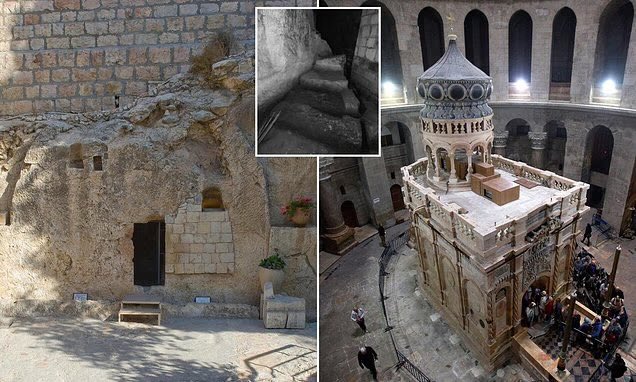
Let’s talk about this. Because every five minutes, modern hyper-intellectual skeptics tell us, “Oh, the Bible? That’s just myth. Ancient folklore. Just a bunch of metaphorical campfire stories cooked up by ancients in sandals.”
And then what happens? Archaeologists start scraping away the floorboards of the Church of the Holy Sepulchre, digging around beneath the dirt where people have been praying for millennia, and they find actual, physical, undeniable dirt-level reality.
What did they find? They found ancient pollen, roots, and traces of olive trees and grapevines dating back precisely 2,000 years.
Now, why is that a big deal? Why is that blowing people’s minds? Because the Gospel of John specifies a very particular, localized detail. He says that right there where Jesus was crucified, there was a garden, and in that garden, a new tomb.
For years, critics looked at that and went, “Yeah, right. A garden? In a rocky, quarry-heavy area outside Jerusalem? Pull the other one.”
Except, the dirt doesn’t lie. The soil samples show that this place used to be an old stone quarry, and then…boom…they filled it in, built little low stone walls, and turned it into an agricultural green space. A garden.
Exactly like some eyewitness account scribbled down two millennia ago claimed it was.
It’s extraordinary, isn’t it? Material reality matching up with spiritual truth. People love to dismiss ancient texts as fiction, but whenever we actually dig down into the earth, we keep unearthing the fact that the writers knew precisely what they were talking about. The geography, the layout, the gardens, the tombs. It’s all matching up.
It makes you wonder: if they got the dirt, the trees, and the topography spot on, what else might they have gotten right?
What do you suppose will be proven correct next? And how do you think those who refuse to see will just find another excuse not to look.
Leave a Reply