I’ve seen this a lot recently. I don’t know why. But it’s a claim that nobody thought Jesus was God until 325’s Council of Nicaea. It’s bunk. We all know it. But it’s nice to see evidence uncovered that shows it so clearly that the Jesus debunkers have to run and hide with their hands over their ears.
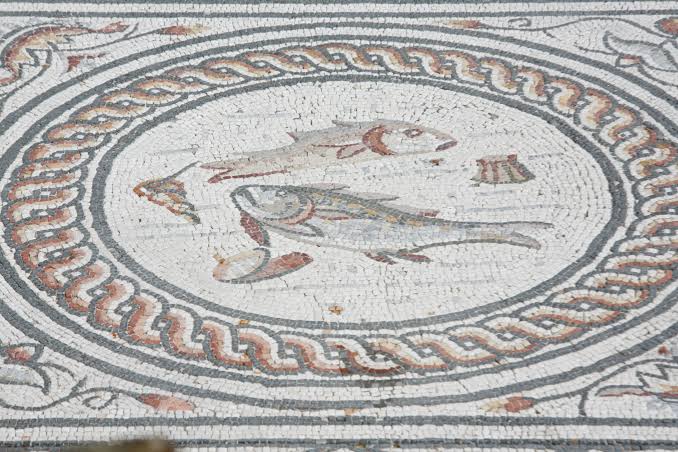
The Megiddo Mosaic, recently exhibited at The Museum of the Bible, is one such example.
Skeptics argue that the belief in Jesus’ divinity developed later in the early church. They say that outside the Bible there’s just no evidence that Jesus is God. But archaeologists keep reluctantly finding evidence that shows that early Christians believed Jesus to be God.
Like when archaeologists uncovered a mosaic church floor near Megiddo dating to 230 A.D. The mosaic includes a Greek inscription reading: “God Jesus Christ.”
Whoops!
And then you’ve got The Alexamenos graffito, an ancient piece of Roman graffiti carved into plaster. Discovered on the Palatine Hill in Rome in 1857, it dates roughly to the late 2nd or early 3rd century AD and is widely considered the earliest surviving visual depiction of Jesus’ crucifixion.
The crude drawing depicts a humanoid figure with the head of a donkey fixed to a cross. To the left, a young man is shown raising his hand in a gesture of prayer.
Directly below the sketch is an inscription written in Ancient Greek:
ΑΛΕΞΑΜΕΝΟΣ ΣΕΒΕΤΕ ΘΕΟΝ (Alexamenos sebete theon)
This translates to “Alexamenos worships [his] god.”
OUCH!!!
You’ve also got The wall paintings of Jesus from the Dura-Europos house-church in eastern Syria (dating to around A.D. 232–235).
One of the wall paintings features Christ (symbolized as a shepherd with a ram) painted directly above the baptismal font.
You’ve also got Christ Healing the Paralytic and Christ walking on water. Kinda godlike, huh?
And then you have all these writings which are kind of a big deal.
Ignatius of Antioch (c. AD 50–117): In his Letter to the Ephesians (ch. 18.2) and other letters, he explicitly refers to Jesus as “our God, Jesus the Christ”.
Polycarp of Smyrna (c. AD 69–155): In his Letter to the Philippians (ch. 12.2), he speaks of belief in “our Lord and God Jesus Christ”.
Justin Martyr (c. AD 100–165): In his Dialogue with Trypho, he argues that Christ is called both God and Lord of hosts.
Melito of Sardis (d. c. AD 180): In his homily On Pascha, he famously proclaims God was put to death in human form.
Irenaeus of Lyons (c. AD 120–202): In Against Heresies (1.10.1), he writes that Christ Jesus is our “Lord, and God, and Savior, and King”.
Tertullian (c. AD 150–225): He explicitly wrote in his treatises that Christ is God and shares one substance with the Father.
And how about a historian from the time?
Pliny the Younger around 112 AD, in a letter to Emperor Trajan notes that Bithynian Christians gathered before dawn to sing hymns to Christ “as to a god” (quasi deo).
Kind of telling.
To be clear, there’s a lot more but this should give us enough to snap back at those who’d like to cover their eyes and ears and push the narrative over truth.