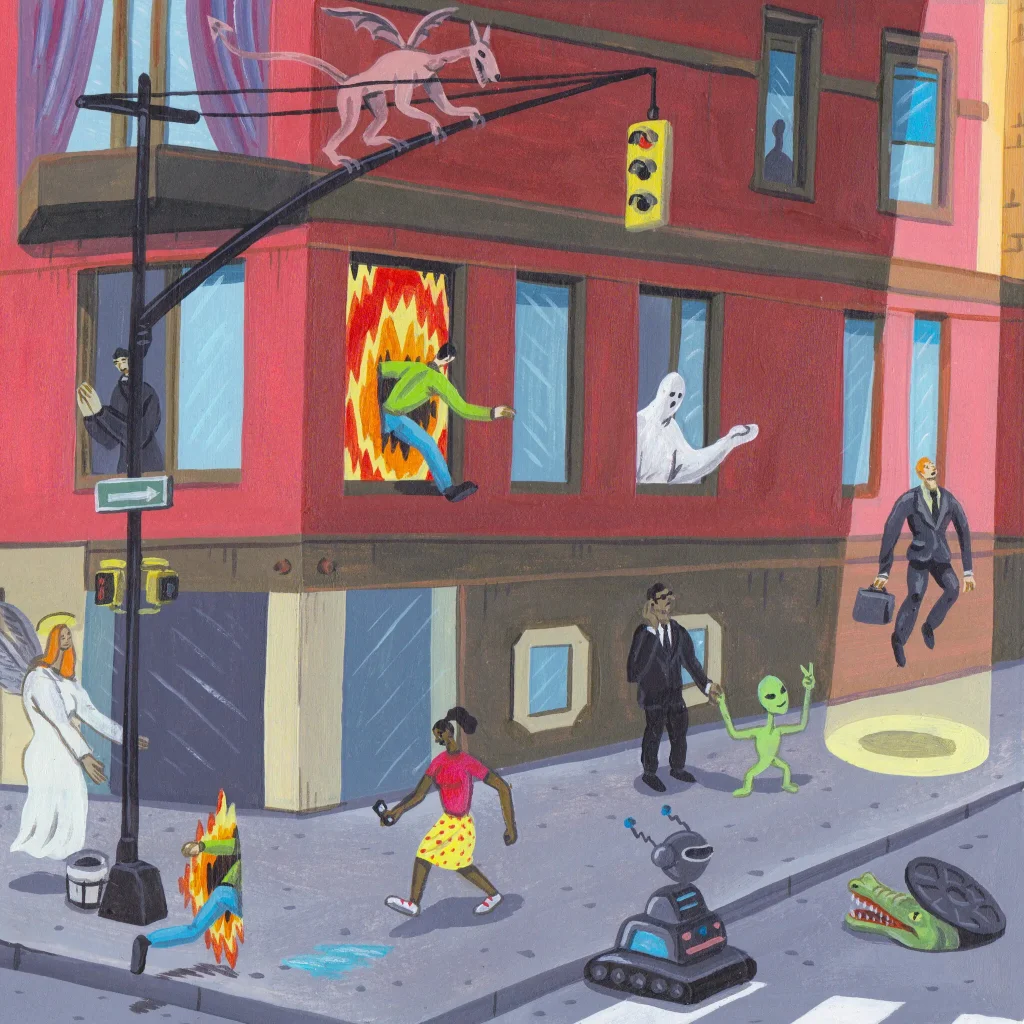
The New York Times is concerned that you’re re-introducing a new Middle Ages. I say, “Welcome back.”
In truth, the world is not “re-enchanting.” It is shaking off a long, unnatural sleep.
The Times piece performs the familiar modernist dance. It observes the return of demons, saints, miracles, and strange happenings with a mixture of fascination and unease, then frames the entire enterprise as a regrettable regression from the clear light of Reason. As if the real world had been politely waiting in the wings while we built our rationalist empire, and now the barbarians of myth are storming back in. This is not a diagnosis. It is the last twitch of a dying paradigm.
We have lived inside that paradigm and left it. We chased environmental truth through politics and science, then through New Age , then through the old occult ways. Each time we searched, we found something true but in the end, incomplete. What we eventually re-discovered is that the world was never disenchanted. We simply stopped seeing its enchantment. It was never eliminated. It was renamed, repackaged, and set to work in the service of the Machine, which gave us a world of screens, data, pharmaceuticals, and managerial control, while quietly hollowing out the soul. Now the cracks are showing. Tucker Carlson wakes with claw marks from a demon. Ha. Ha. Ha. Point and laugh, boys. A senior official claims teleportation. Weirdo, amirite? Young men are flooding into Catholic parishes in numbers never seen before. Of course this is happening. When the dominant story collapses, older and deeper stories reassert themselves.
The author worries that without proper “foundations” this re-enchantment will slide into conspiracy and madness. Fair enough. But what were the foundations of the disenchanted world? A supposedly neutral, objective rationalism that reduced Creation to raw material, the human person to a sovereign self, and the divine to private sentiment or outright superstition. That project has delivered us an ecocide, a meaning crisis, and institutions that lie with industrial efficiency. It is not medieval to notice this. It is medieval to pretend otherwise.
I do not say all spirits are benign. The spiritual realm is real, and therefore dangerous. The Church warns against witchery and the occult not because they’re laughably ineffective but because they’re dangerous. The New Age currents, the digital sorcery, the Gnostic dreams of uploading the self or merging with silicon are not harmless alternatives. They are often the Machine wearing occult clothing. The principalities and powers do not care whether you reach them through an Ouija board, a DMT trip, or a neural interface. They adapt. If you call to them, they will respond.
The world is sacramental. It always was. The recent materialist interlude was the anomaly. When a culture tries to live as if only matter exists, deeper realities press back in. What the modern mind calls “superstition” our ancestors called participation. The saints, the liturgy, the icons, the fasts, and the prayers were not psychological props. They were the architecture of a rightly ordered life in a living Creation shot through with the presence of God.
This is why the conversions to Catholicism matter. These are not retreats into irrationality. They are returns to the tradition that takes the unseen seriously without surrendering the mind to every passing spirit. They offer not self-deification but the hard road of becoming more like God in my everyday life. They root you in something older, deeper, and more real than the news cycle or the algorithm.
The author is right that we are moving into a world saturated with the supernatural. The question is not whether we will believe in something. It is what, or Whom, we will serve. The Machine offers one path. What is that path? Ever-greater abstraction, ever-greater control, ever-greater disconnection from soil, ancestry, and the living God. The old faith offers a path of humility before mystery, repentance, rootedness, and participation in the divine life that still pulses through this wounded Earth.
I know which one I chose. I try to live it every day. The claw marks on Tucker Carlson’s skin are not a metaphor. Neither is the quiet pull that brings broken young men into the incense and the icons. The world is not sliding backwards. It is, painfully and against our will, beginning to wake up.
The real regression was the disenchantment. Thank God it is failing. Now comes the choosing.
Time is short to gather in these young men. I don’t take any of them for granted. Consecration to the Sacred Heart called for by the US bishops for America. I’m going to do it
I assume all of you will return to Medieval dentistry, plumbing, and hygiene habits? You already want Medieval marriages — old men buying teenage girls to rape until the girl died in childbirth after 15 kids and being able to beat her for looking at you the wrong way — so I assume you want all the diseases and death as well. I KNOW you all fantasize about burning heretics; you’ve said you want that.
You can’t have modern health and life expectancy without modern thought. If you continue using the modern toilet and shower, you’re a hypocrite.
You know that modern science developed in part because of Aristotle’s categories , right? And building on the Judeo Christian philosophy that the universe is intelligible, and growing out of a Catholic Middle Ages that invented the modern university? That’s where science came from, Karen.
So let your dentist know you won’t be seeing him anymore
Certainly I know that modern medicine started in the past. The difference between you and me is that I don’t have a foolish emotional attachment to the ideas of the past. We’ve learned stuff since Aristotle.
I assume you agree with Aristotle and Thomas Aquinas that women are genetically stupid? Aquinas did at least allow us to be human, unlike Aristotle, but he said we were deficient in reason and entirely and utterly inferior to men. That’s the world you want.
“…but he said we were deficient in reason”… If he did say that, then that explains why some women kill their unborn babies…and celebrate it.
So you do think women are inferior to men just like Thomas Aquinas and the Catholic Church have always taught.
I’m not going to persuade you to change your mind. I want you all to quit lying about Catholic doctrine about women and admit that your church says women are worthless dirt.
If your point is that it is objectively true that women have rights, then you should thank Aristotle first and Aquinas second
I would say thank God primarily and above all, but since you don’t believe in God, go with Nietzche.
He recognizes some kind of overlord called the Ubermensch (male, it would seem, in other words, a guy) who has all power and is beyond good and evil, so let’s not worry about rape or murder because they are nothing to him.
Or try appealing to Stalin for mercy or Hitler. The Pride people are increasingly concerned only about power and you might ask them about your speech and religion.
If that’s the kind of world you want. But don’t appeal to a Church that recognizes your rights and dignity as a child of the Father because you won’t get anywhere